
UX internship at Nutanix
UX internship at Nutanix
NUTANIX DATABASE SERVICES
NUTANIX DATABASE SERVICES
DBaas product
NDB helps users manage & monitor databases
B2b complexity
Designed alerts for database & VM malfunctions and errors
Alerts framework
Designed a framework that can be scaled & applied to all products
DBaaS
Enterprise
Alerts
Error:
This project is only available to view on desktop or tablet
NDB alerts framework
Context
Context
Nutanix Database Services (NDB) is a database management software, where users can bring in and manage databases as well as set up automated backups.
My internship project involved working on the alerts framework of NDB.
Nutanix Database Services (NDB) is a database management software, where users can bring in and manage databases as well as set up automated backups.
My internship project involved working on the alerts framework of NDB.
Process
Understanding NDB
Understanding NDB
As a novice to the cloud infrastructure space, my first step was to ask as many questions as possible and understand the NDB in as much depth as I could, keeping the timeline in mind.
The challenge of attempting to understand the heavily technical product was one I enjoyed taking up.
As a novice to the cloud infrastructure space, my first step was to ask as many questions as possible and understand the NDB in as much depth as I could, keeping the timeline in mind.
The challenge of attempting to understand the heavily technical product was one I enjoyed taking up.
Error mapping
Error mapping
First, I worked on understanding what problems arise that raise alerts in NDB. I went through client complaints about alerts they approach support for, and mapped out those with what goes wrong on the infrastructure level.
First, I worked on understanding what problems arise that raise alerts in NDB. I went through client complaints about alerts they approach support for, and mapped out those with what goes wrong on the infrastructure level.

Competitor analysis
Competitor analysis
Reviewing alert documentation of various competitors gave me insight about best practices, what sets various products aside from the others and inspiration along what lines I can diverge my ideation.
Reviewing alert documentation of various competitors gave me insight about best practices, what sets various products aside from the others and inspiration along what lines I can diverge my ideation.
Analysis
Analysis


Analysis
The current alerts framework for NDB generates too many alerts, burdening the user on email as well as the alerts section. The alerts lack clarity and aren’t actionable, leaving the users confused about how to troubleshoot. They also lack customization and categorization in terms of who receives each alert, and insight into what type of issue it is.
The current alerts framework for NDB generates too many alerts, burdening the user on email as well as the alerts section. The alerts lack clarity and aren’t actionable, leaving the users confused about how to troubleshoot. They also lack customization and categorization in terms of who receives each alert, and insight into what type of issue it is.
Key problems
Key problems
Too many alerts
Not actionable
Lack of clarity
No help for troubleshooting
Lack of categorization
No control to user
Ideation
Ideation
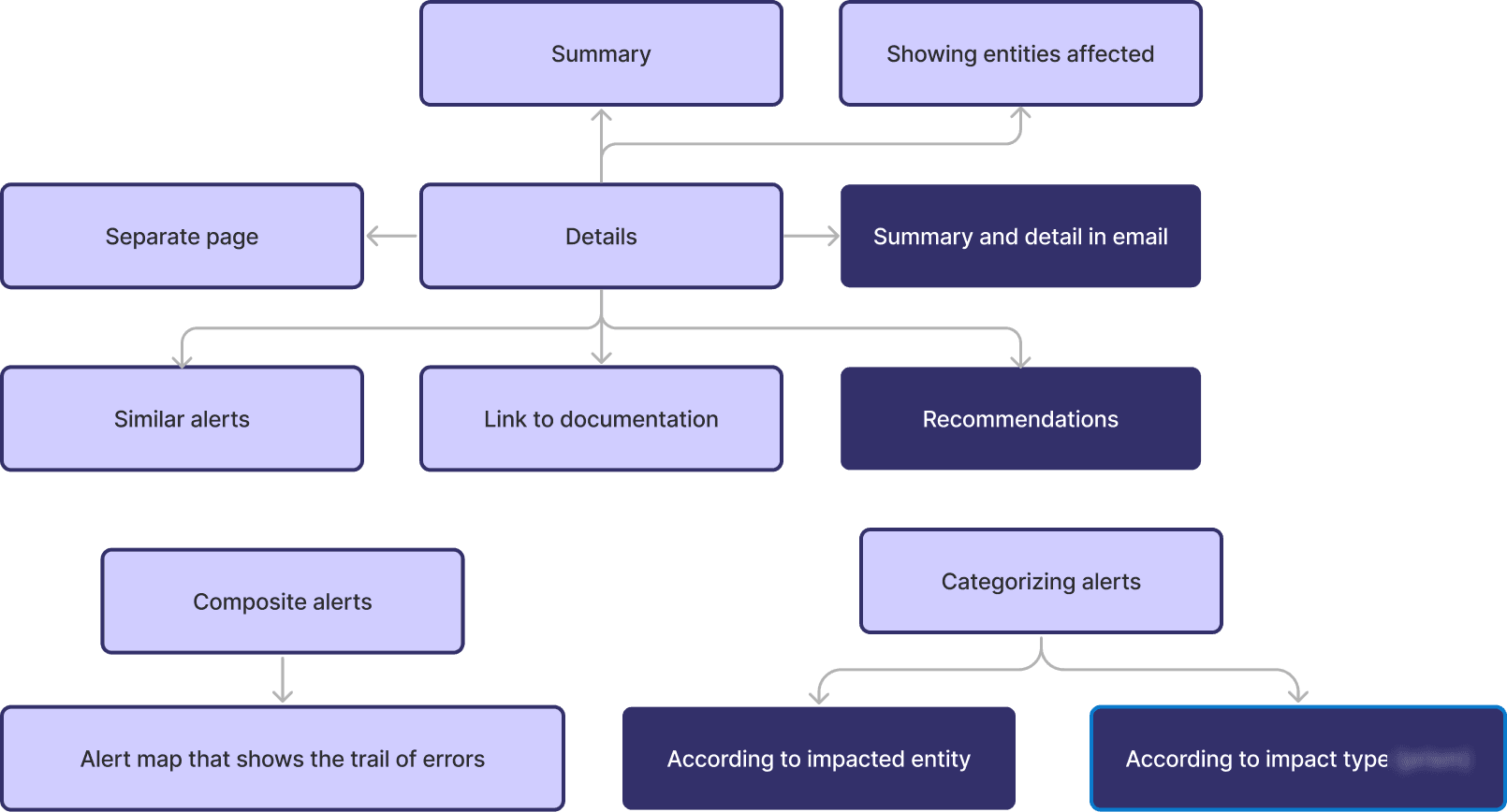
Ideation was the most fun part, where the loose process I followed was to branch out from problems and develop a thick web of interrelated ideas.
Ideation was the most fun part, where the loose process I followed was to branch out from problems and develop a thick web of interrelated ideas.
Key phrase
Key phrase
“Giving the users the reins”
“Giving the users the reins”

Key phrase
Key phrase
Alerts should be actionable
Alerts should be actionable
Solution
Solution
The solution process was iterative, with a lot of communication with the PMs, SREs and feedback sessions with the design team. This helped adapt the solution to various use cases as well as develop a solid foundation for the final solution that has been reviewed by many stakeholders.

User defined alerts
User defined alerts
The first solution that helped users gain control was to let them define their own alert raising policies.
A list of out of the box policies would be pre-defined, which could be cloned and edited to the user’s own metrics and preferences.
The first solution that helped users gain control was to let them define their own alert raising policies.
A list of out of the box policies would be pre-defined, which could be cloned and edited to the user’s own metrics and preferences.
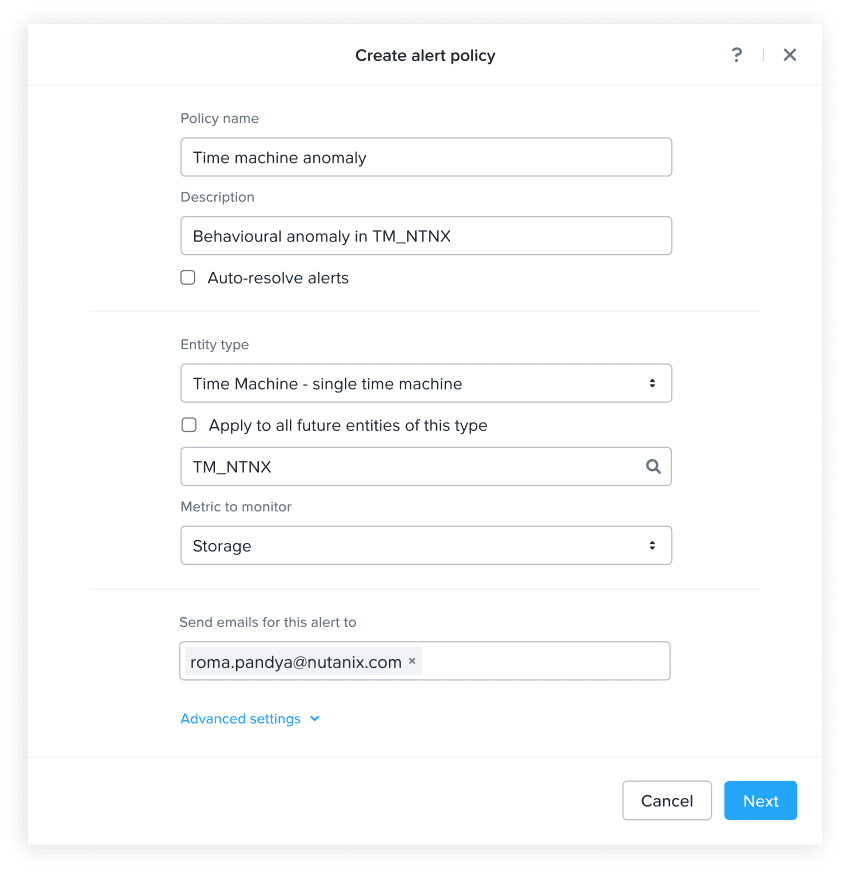
The user can define the parameters related to what entity they want to be alerted about, what metric of the relevant entity to monitor and advanced settings such as at what threshold should the alert be raised.
Now, the user has fine-tuned control over exactly what, when and how they want to be alerted about an error.
The user can define the parameters related to what entity they want to be alerted about, what metric of the relevant entity to monitor and advanced settings such as at what threshold should the alert be raised.
Now, the user has fine-tuned control over exactly what, when and how they want to be alerted about an error.

Composite alerts
Composite alerts
There is a certain type of alert, which is a chain of events kind of alert, which is not accounted for in the existing framework. When one error causes a multitude of errors, which would all be fixed if the original error is resolved, that is where the concept of composite alerts comes in.
To see the nature of this interrelation and to save a lot of time in troubleshooting, the following is the solution I proposed.
There is a certain type of alert, which is a chain of events kind of alert, which is not accounted for in the existing framework. When one error causes a multitude of errors, which would all be fixed if the original error is resolved, that is where the concept of composite alerts comes in.
To see the nature of this interrelation and to save a lot of time in troubleshooting, the following is the solution I proposed.

In the list view in the alerts section, the user can differentiate the composite alert from others, by a tag of “3 related” which tells how many alerts are caused by the original alert which is displayed in the list itself.
The next step the user will take is to resolve the alert on top, instead of having to do the math in your head to figure out which alerts are related and how to go about troubleshooting.
In the list view in the alerts section, the user can differentiate the composite alert from others, by a tag of “3 related” which tells how many alerts are caused by the original alert which is displayed in the list itself.
The next step the user will take is to resolve the alert on top, instead of having to do the math in your head to figure out which alerts are related and how to go about troubleshooting.

Personal
takeaways
Personal
takeaways
I learnt a lot about the data infrastructure enterprise space, and even though the work was very technical, it was interesting and challenging work for me on my journey as a designer. I got a look at the design process in a company that cares a lot about user experience and I learnt a lot about communication with a multidisciplinary team.